


DIGITIZATION OF HISTORICAL AUDIO COLLECTIONS with IRENE TECHNOLOGY
The IRENE audio preservation service at NEDCC is the culmination of a decade of research and development at the Lawrence Berkeley National Laboratory and the Library of Congress.
Using a non-contact, optical scanning approach, IRENE is designed for the preservation of fragile and historically significant sound recordings. This technology creates ultra-high resolution images of audio groove structures in 2D or 3D, depending on project requirements. These images are processed through specialized software to generate an audio file. When properly preserved, the image files also serve as a digital surrogate of the original object, documenting its condition at the time of scanning and supporting long-term preservation while minimizing handling of the physical carrier.
Advantage of IRENE
IRENE is particularly well suited for media that are fragile, damaged, or difficult to reproduce using traditional stylus playback, as well as for formats where playback equipment is obsolete. Because the process does not rely on mechanical contact, it eliminates the risk of stylus wear and is often the safest option for unique or compromised recordings.
Image-based processing can also identify and reduce certain surface-related noise artifacts—such as clicks, crackle, hiss, and pops—improving the clarity of the resulting audio. More extensive audio restoration using traditional signal-processing techniques may be carried out by specialized providers if desired; however, this work falls outside the scope of NEDCC’s services.
Common Formats:
- Wax cylinders
- Lacquer discs (a.k.a., “acetate” discs)
- Aluminum transcription discs
- Shellac discs
- Tin foils
- Other rare formats (e.g.,Voicewriter, Audograph, Soundscriber Discs, etc.)
Preservation-Focused Approach
As a nonprofit conservation center, NEDCC is committed to preserving both audio content and the physical carriers that hold it. IRENE supports this conservation ethic by providing a preservation pathway that does not require choosing between safeguarding the artifact and accessing its recorded sound.

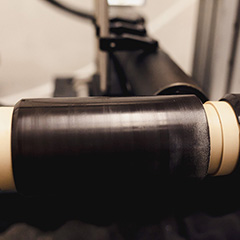

Client Stories:
> Putting the Band Back Together! Using Cutting-edge Technology to Recover Sounds from the Past
> Early Edison Cylinders Imaged at NEDCC's IRENE Lab
> Preserving a Legacy: Digitizing Jorge Eliécer Gaitán's Broken Recordings
DESCRIPTION OF IRENE AUDIO PRESERVATION SERVICES
Preservation Files
The IRENE technology creates uncompressed Broadcast WAV audio preservation files in compliance with IASA standards and FADGI guidelines. In addition to the audio preservation files, ultra-high resolution TIFF image master files are created to document the groove structure and physical condition of the media.
All transfers are performed 1:1—meaning an NEDCC audio engineer listens to the entire recording during the digitization process, making adjustments when necessary, if for example, the sound quality shifts.
Preliminary Assessment & Sample Reformatting
In some cases, it may be useful to digitize a small portion of a collection before moving forward with a full project. For a preliminary pilot project, we recommend selecting one disc for complete scanning and digitization. This provides sufficient audio to evaluate content while minimizing handling of the carrier. NEDCC will work with you to identify an appropriate item for sampling and can also provide an in-house inventory and condition assessment of the full collection, if desired.
Pilot projects are also beneficial for gathering support materials for writing a grant application or simply making prioritization/selection decisions.

Cleaning
IRENE is able to digitize dirty carriers, however, appropriate cleaning prior to imaging typically results in higher-quality capture.
As a conservation laboratory, NEDCC adheres to the Code of Ethics and Guidelines for Practice of the American Institute for Conservation (AIC). Clients receive written documentation outlining proposed cleaning methods. Only established, conservation-approved techniques are used, and treatment information is fully documented and shared. For more information, see Cleaning Lacquer Discs.
Rehousing
Original housing can pose preservation risks for certain audio formats. Acidic sleeves used with lacquer discs may accelerate plasticizer exudation, while fibers from the cotton linings of wax cylinder containers can become embedded in the grooves.
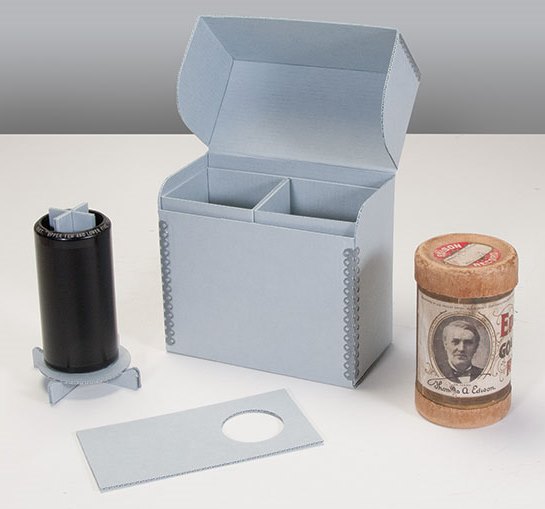
NEDCC recommends rehousing lacquer discs and wax cylinders, and can provide appropriate enclosures as part of a project. Institutions that choose to rehouse materials independently should use archival-quality, acid-free enclosures from reputable preservation suppliers.
For wax cylinders, NEDCC has collaborated with University Products on a housing design that stores the cylinder and its original container together in the same box, in separate compartments. This design supports the fragile carrier without contacting the grooves and preserves the original container, which may contain important metadata.
Condition Assessment
A condition assessment provides baseline documentation of an audio carrier, followed by periodic reassessment to monitor changes over time. This service is particularly valuable for rare or significant carriers that are important not only for their audio content, but also as physical artifacts.
IRENE’s imaging approach captures detailed, measurable information about an item’s surface and groove structure, offering a level of condition documentation not possible through visual inspection alone.
Conservation Treatment
We are also working with objects conservators who specialize in polymers, lacquer, glass, and metals to develop treatment techniques for stabilizing damaged discs and cylinders. Because the goal is performance rather than aesthetics, we are focusing on approaches that will maintain the integrity of the signal quality. This service is not yet available, but please feel free to contact us for further information.
Did you know?
I.R.E.N.E is an acronym for 'Image, Reconstruct, Erase Noise, Etc.' It was so named because the first audio retrieved with the system during its development at Berkeley Lab was a recording of “Goodnight Irene” by the Weavers, one of Carl Haber's favorites. They have also so named the IRENE editing software "Weaver."
Questions?
|
About audio preservation projects and scheduling: Bryce Roe |
About receipt and return of your materials, or packing and shipping: Jonathan Goodrich |
LEARN MORE

Stories and sound clips from the IRENE pilot projects